
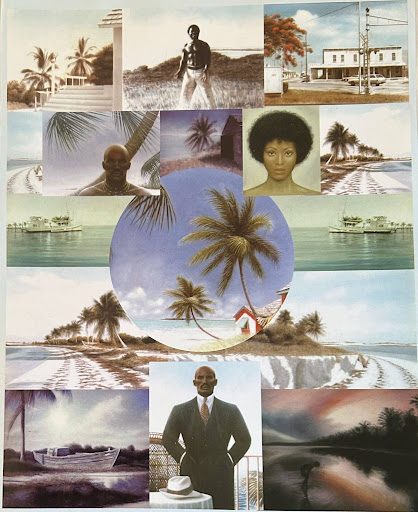

“A staggering variety of sub-themes and styles best united by one common thread running through them all: the American Dream. It’s man’s universal search for his lost Eden. Perhaps no other artist plumbs the depths (or heights) of it all as plaintively as Augustine Schmitt.” THE PARISIAN PERSPECTIVE
“America – past and present, memory and myth – underneath it all is an unspoken yearning that’s undeniably there somewhere just beyond Gatsby’s reach that beckons us all.” THE LEFT BANK PREVIEW
Reviews of our narrator’s paintings. The second novel of the trilogy – Confessions of St. Augustine where our narrator’s outward success is belied by his inward failure. Ironically built on his very American Dream.
“All part of that innate desire we all have to see ourselves as beautiful and the wish to celebrate the beauty of the natural man. The Noble Savage doesn’t live in Detroit or Pittsburgh or Gary, Indiana or even the deserts of Arizona – no – he lives in the beautiful tropical islands with its trade winds and its ideal climate yes where you can run down those beaches in celebration of life, your life, your body, your surroundings – where ‘life is good’ – not hard, not suffering, and therein lies the problem…
“because you know someday suffering, decay and death will triumph: Richard Corey killed himself. Gauguin died of syphilis..
“and I thought how nice it’d be if it really were true.. what we all came here for… that endless celebration that can only be hoped for in those beautiful tropical islands…”
The American Dream.
A metaphor for Eden. In all three novels, The Mendicant, The Militant, andThe Missionary our narrator, Augustine, paints it, draws it, talks about it, searches for it, philosophizes about it and as the above paintings may suggest, goes back to its origins when the first Europeans set foot on the Western Hemisphere:
“That had once pandered in whispers to the last and greatest of all human dreams; for a transitory enchanted moment man must have held his breath in the presence of this continent, compelled into an aesthetic contemplation he neither understood nor desired, face to face for the last time in history with something commensurate to his capacity for wonder…”
But it was too late for Gatsby, because
“somewhere back in that vast obscurity beyond the city, where the dark fields of the republic rolled on… it eluded us then, but that’s no matter – tomorrow we will run faster, stretch out our arms farther…. And one fine morning -“
But not for Augustine. And the temporal theme of his paintings only confirmed it. The old Eden only confirmed the desire for a new Eden. And since the American Dream has become a nightmare, there must be a heavenly one based on the one we all share. So instead of the physical manifestation, there must be a metaphysical one yet to be. And that’s where his pilgrimage begins. Where the other Augustine’s ended: The City of God.
Of course, as you can see from the collage, there’s another City of God that might come to mind too. The flipside of the dream – the corruption of the New World if you’ve seen the movie of the same name. A Brazilian Goodfellas that’s more akin to the pace and tone of Confessions’ narrator, albeit not unlike the original St. Augustine. “God, make me pure, but not yet.”
Both are a story of redemption, while living in a corrupt world. The movie merely reminds us of the paradise lost. And what better place than Rio De Janeiro. The image is almost mythical. Flying Down to Rio.
Why?
Early Hollywood does a whole Busby Berkeley on it, camp as it is. It still held out hope life was more than the mere drudgery of a Macbeth soliloquy. And what was it the original Augustine said?
In so many words, what the Westminster Catechism said:
“The chief end of man is to glorify God and enjoy Him forever.”
And where does our narrator end up? Not in any earthly paradise. But quite the contrary. The desert.
To be continued…