
Author
James Mueller
Author and fine artist James Mueller’s work bridges contemporary literature, philosophy, and visual art. He is the author of Confessions of St. Augustine (second edition), a genre-defying work published by Iconoclast Publishing that combines austere prose with his original artwork. Often compared to Catcher in the Rye, the book is recognized for its raw introspection, moral inquiry, and uncompromising voice.
Mueller’s literary work continues with The Donnie Diaries series, beginning with An Ode to Ipecac and expanding through subsequent volumes. The series fuses satire, spiritual reckoning, and cultural critique, confronting power, misinformation, and moral erosion with clarity and precision, and establishing Mueller as a singular voice in contemporary art literature.
As a fine artist, Mueller has exhibited internationally, including in Paris, New York, Washington, D.C., and Miami. He holds an Honorary Doctor of Arts degree and lives in Arizona, where he has spent more than two decades working with individuals with intellectual and developmental disabilities and serving within the Apache community. These experiences continue to inform and shape his work.
MY BOOKS

Confessions of St. Augustine (Second Edition), a literary memoir, blends philosophical reflection with visual art. This edition explores faith, solitude, rebellion, and the unending pursuit of creative truth.
Combining layered narrative with selections of Mueller’s original artwork, the book offers an intimate portrait of an artist defined by moral inquiry and creative defiance. Mueller’s prose is disciplined yet raw, meditative, unsparing, and intensely human, appealing to readers who value substance over spectacle.

The Donnie Diaries: An Ode to Ipecac is the provocative opening novel in a four-book literary series that blends satire, political critique, and spiritual reckoning. The novel confronts power, ego, masculinity, and moral collapse through language that is lyrical, abrasive, and darkly humorous.
Combining philosophical monologue and cultural autopsy, the book rejects the comfort of traditional narrative in favor of confrontation. Absurdity reveals truth, confession becomes indictment, and readers are invited into a charged literary experience that endures beyond the last page.

The Donnie Diaries: Redux is the second volume in James Mueller’s four-book series, extending the satirical and philosophical framework introduced in An Ode to Ipecac.
Redux sharpens its focus on perception, illusion, and power—tracing the forces that shape belief and sustain spectacle. Through recurring voices and evolving monologues, Mueller deepens his examination of ego, complicity, and cultural distortion.
Blending satire with a poetic sensibility, the work moves with precision and restraint, exposing the unstable boundary between performance and truth.
Released on April 1, Redux positions April Fools’ Day as a structural counterpoint to the series’ Halloween debut—shifting from mask to mirror. As the second installment in The Donnie Diaries Series, it advances a central proposition: that satire, at its most exacting, is not exaggeration, but revelation.

The Donnie Diaries: Retired is the third volume in James Mueller’s four-book series, extending the satirical and philosophical framework introduced in An Ode to Ipecac.
In this third installment of The Donnie Diaries, Redwell returns with another whirlwind tour through politics, religion, literature, history, philosophy, popular culture, and whatever else happens to wander into his increasingly overworked imagination. One moment he’s wrestling with God, the next he’s arguing with atheists, quoting Shakespeare, defending the Jews, ridiculing Trump, romanticizing revolution, or trying to make sense of a world that seems determined to become a parody of itself.

James Mueller
Author
My Story
James Mueller, an esteemed author and artist, holds an Honorary Doctor of Arts degree, a testament to his significant contributions to the arts. His artistic journey has taken him globally, with notable solo exhibitions in Paris, New York, Washington, D.C., and Miami. He resides in Arizona, maintaining a life of anonymity, known only to his three children, Tashua, Ali, Lizzie, and the IRS.
James Mueller is the author of “Confessions of St. Augustine,” published by Iconoclast Publishing. The book is comparable to “Catcher in the Rye,” an extensive collection of his art.
In 1976, Mueller’s work caught the eye of Robert Abplanalp, a wealthy business tycoon, who sponsored a solo exhibition at the prestigious Gallery Chardin in Paris. Despite a postal strike that hindered the invitations’ delivery, the exhibition drew key critics, resulting in glowing reviews. These reviews and Mueller’s paintings remain integral to his book promotions.
Initially hesitant to embrace his radical ideas, Mueller’s alma mater later recognized his achievements with an honorary doctorate, the first in the institution’s history. This honor, a testament to his unwavering dedication to his craft, marked a turning point in his career, leading to further accolades and solo exhibitions.
Beyond his artistic endeavors, Mueller dedicated over twenty years to working and living with individuals with intellectual and developmental disabilities and crafting his trilogy of novels in a monastic environment. This lifestyle allowed him to focus on his writing, free from the pressures of the art world.
For the past decade, Mueller has lived and worked with the Apache Indians on a small mission, deeply integrating into their culture and being asked to serve as their youth director and baseball coach. This bond has enriched his artistic and literary work. His art career took a miraculous turn in 1976, just two years after he started, when a trustee of Miami University showcased his work. An influential man with companies in 19 countries bought his entire collection, leading to one-person shows, a gallery for the New York State Indian collection, a portrait of Nixon, and numerous international exhibitions, including a Paris show. These experiences have solidified Mueller as a distinctive and influential figure in the art world.

“The visceral of a Burchfield, the vision of a Hopper, the virtuosity of a Wyeth and you begin to understand the paintings of Augustine Schmitt.”
–CONNOISSEUR DES ARTS

“The painter is becoming a veritable voice of his times… his pastels—portraits and landscapes—combining the soul of a Homer and the eye of an Eakins—has hit France like the D-Day invasion—Yes, Paris is burning, but this time not at the cost of its art.”
–PLEIN AIR OF PARIS

“Schmitt is indisputably one of the best artists in decades to capture the essence of America’s international aura, evoking an America of the movies we grew up on—James Dean, Paul Newman, and Marlon Brando—an MGM color pallet with a Warner Brothers bite—Chuck Jones let loose in the art department…”
–JET SET INTERNATIONAL
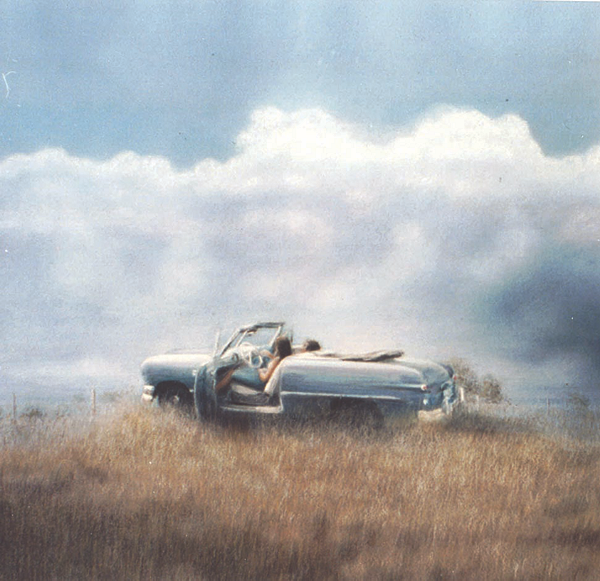
“Jack Kerouac with a paint brush. Hop in your woody, and “get your kicks on Route 66″ because Gus Schmitt takes you down a road that has turned into American myth: Tod and Buz in their Corvette, Brando on his motorcycle, or Huck and JIm floating down the Mississippi—it’s all there…”
–PARIS ARTS

“A staggering variety of sub-themes and styles best united by one common thread running through them all: the American Dream. It’s man’s universal search for his lost Eden. Perhaps no other artist plumbs the depths (or heights) of it all as plaintively as Augustine Schmitt: 16th century Indians and 20th century Main Street America? See for yourself. It’s a feast for the eyes.”
–THE PARISIAN PERSPECTIVE

“America—past and present, memory and myth—underneath it all is an unspoken yearning that’s undeniably there somewhere just beyond Gatsby’s reach that beckons us all. If truth be told, too many critics today may know a lot about art, but don’t know what they like. Gus Schmitt’s recent one man show on the Left Bank may not resolve that question, but it’ll go a long way to restoring the validity of the former—‘but I know what I like!'”
–THE LEFT BANK PREVIEW

“And the critics come and go casting aspersions to and fro, but unlike the pretentious pedants of T.S. Eliot’s ‘Love Song,’ Schmitt’s love song lays bare Pruefrock’s hesitation to descend the stair—with a bald spot in the middle of his hair—by shaving it all off!”
–THE SYMBOLIST
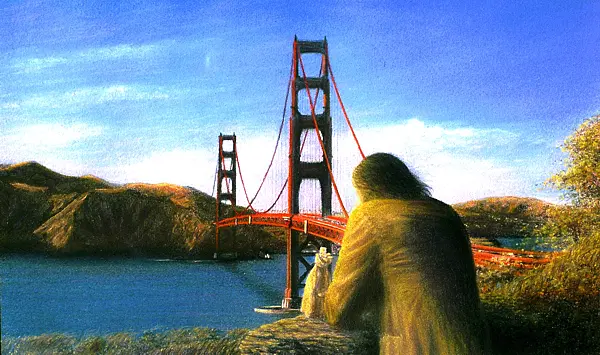
“Schmitt plays with the sacred and then tears it apart. Then turns around and picks up the pieces and makes them sacred. A master of capturing our icons while at the same time reminding us just how ephemeral they all are.”
–THE ROUSSEAUIST REVIEW