
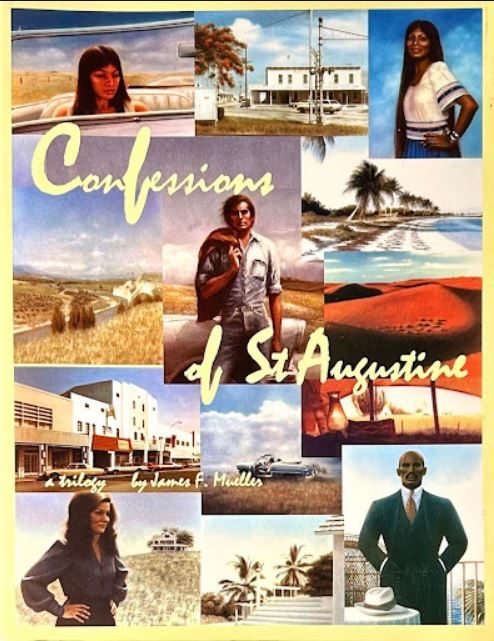

My Take on Confessions of St. Augustine?
So now that I’m going to be delving into The Donnie Diaries, current events and how they all connect with Confessions, let me give you my take in as MUCH depth in as little time as possible, so we can move on:
So, buckle your seat belts ladies and gentlemen (dear readers) – we’re going to take a crash course in world lit. in all of about five minutes:
A 21st Century Tristram Shandy, Ulysses, Finnegans Wake, Remembrance of Things Past, The Man Without Qualities, Confessions of Zeno (and if you want to throw in Clarissa, Dream of the Red Chamber, The Tale of Genji, Gravities Rainbow, The Peony Pavilion [a play which takes over 23 hours to perform], and War and Peace for a breather [not one of which in paperback is smaller than a New York City phone book with print you’d only see on a pill bottle], be my guest, but the first few should suffice to send Eliot’s still point into a Yeatsian gyre])…
Still with me?
Then take a deep breath, put your thinking cap on and let’s start with James Joyce’s Ulysses– which takes place during the day (awake), and then the flipside, Finnegans Wake, which takes place at night (asleep), where our deepest unconscious lies (pun intended); and while the Confessions (of our hero) is a simple read on one level—like Ulysses, Finnegans Wake (and let’s throw in Eliot’s “Wasteland” for good measure)—there are levels of meaning that go far beyond the obvious – for example, Old World mythological references like Greek and Roman mythology such as The Iliad and The Odyssey, The Aeneid and the Eclogues, the plays of Sophocles, Aeschylus and Euripides, the poems of Ovid, Petrarch, Horace, and Catullus [you know the kind—the kind every serious artist had to refer to to prove his merit]) are now supplanted by what is uniquely American – consequently absorbing the Greco-Roman Christian-Judaic themes as well as the themes of other classic greats – by Dante, Milton, Cervantes, Shakespeare, Marlow, Goethe, Wordsworth, Keats, Blake, Donne, Dostoyevsky and the list goes on and on – and not to be chauvinistic, but those themes are ultimately explored even further in themes that are now UNIQUELY AMERICAN: Gatsby’s green light, Huck Finn’s territories he has “to light out to,” even the dark side of Nathaniel West’s Day of the Locust (not to mention Miss Lonelyhearts)—and although ALL are uniquely Christian-Judaic as well as Greco-Roman in origin, WE GO ONE STEP FURTHER – so – to put it all in the all-American, easy to sum up, all in a “nutshell,” TRAINING WHEELS VERSION, HERE’S A QUICK SUMMARY!!! –
CONFESSIONS OF ST. AUGUSTINE (a 21st Century post post-modernist novel [not for the post post-modernist deconstructionist])
Cliff Notes version:
Our hero: a New Yorker. The Conflict: a lot of Sturm und Drang. The Cause: coffee. The Solution: no more coffee (but that would be too easy [even for Cliff Notes (no more coffee, no more story)] – no, a tome of this magnitude dear readers, demands a more erudite reason than just coffee – especially when we’ve got BP, ADD, ADHD and a whole host of other disorders out there to choose from – not to MENTION – the POV!! –
FOR example: 1 – to the traditionalist, this story could be seen as a Greek tragedy (as seen in the first novel). 2 – to the modernist, it could be seen as a tragicomedy (as seen in the second novel). 3 – to the post-modernist – perhaps a campy melodrama with a lot more Sturm und drang, caricaturized by bipolar disorder and a lot of other disorders PARODYING THE FURIES OF GREEK TRAGEDY (as seen in the third novel). 4 – and for the post-post-modernist – a kitschy little DISNEY CARTOON with a whole FANTASIA of disorders multiplying exponentially like all those brooms in The Sorcerers Apprentice SWEEPING AWAY ANY SEMBLANCE OF SANITY NOW (as seen in all three novels). 5 – and to the post-post modern deconstructionist – A BUSBY BERKELEY-BROADWAY-EXTRAVAGANZA! – WAVERING BETWEEN PIANISSIMO AND FORTISSIMO PYROTECHNICS! – WITH ENOUGH JUNGIAN ARCHETYPES, FREUDIAN SYMBOLISM AND LITERARY IMAGERY TO OBSCURE ANY point of view (as seen in NONE of the novels) all of which brings us back to where we started in the first place and probably the CAUSE of the whole thing!
New York. (Minimalist POV).
Conclusion: you can take the boy out of New York, but you can’t take New York out of the boy.
Because from New York to L.A., from Miami to the deserts of Arizona, the Confessions of St. Augustine, a trilogy (The Mendicant, The Militant, andThe Missionary) takes the reader on a roller coaster ride of emotions, places, and changes – from the portrait of the artist as a young man to his final apocalyptic vision of America, the world and ultimately life itself, chronicling the spiritual journey of an artist in the latter half of the 20th century to the present, narrated and illustrated by the artist himself:
Because sometimes spokesman, sometimes dreamer, sometimes Walter Mitty with a paintbrush, Augustine Schmitt paints an America we’ve all believed in at one time or another but whether it’s really just kitsch, camp, or commercialism, however, is another story because running counterpoint to this paean to the America of our youth is the voice of a Holden Caulfield grown up into an Alexander Portnoy debunking the very America he’s now painting masking his talent with a “wise guy” facade, he finds more justification creating chaos out of “order” than order out of chaos THUS THE TITLE OF THE FIRST SECTION OF THE FIRST NOVEL: “PORTRAIT OF AN AMERICAN WISEGUY.”
So, in summa denique conclusio respite finem:
“The voice of a Holden Caulfield, Alexander Portney, Robin Williams, Jack Nicholson AND YES – EVEN A SAMUEL L. JACKSON! (for starters) BUT THE YIN AND YANG OF MODERN MAN IN ALL HIS BIPOLAR GLORY – WAVERING BETWEEN AUGUSTINE AND AUSCHWITZ, SARTRE AND CERTAINTY – HEAVEN OR HELL… – but desperately searching for meaning with little more than his words and his art as a means to express it. A wild, manic, full-throttle ride through our subconscious dreamscapes.”
So…. exactly four minutes and thirty seconds. Ya get all that?
No?
Forgedaboudit.
Read the damn book.
Dr. Phineas T. Redwell